updated 7 September 2026
25 pages · 6 sections
questions: Discord ↗
Ask Grid
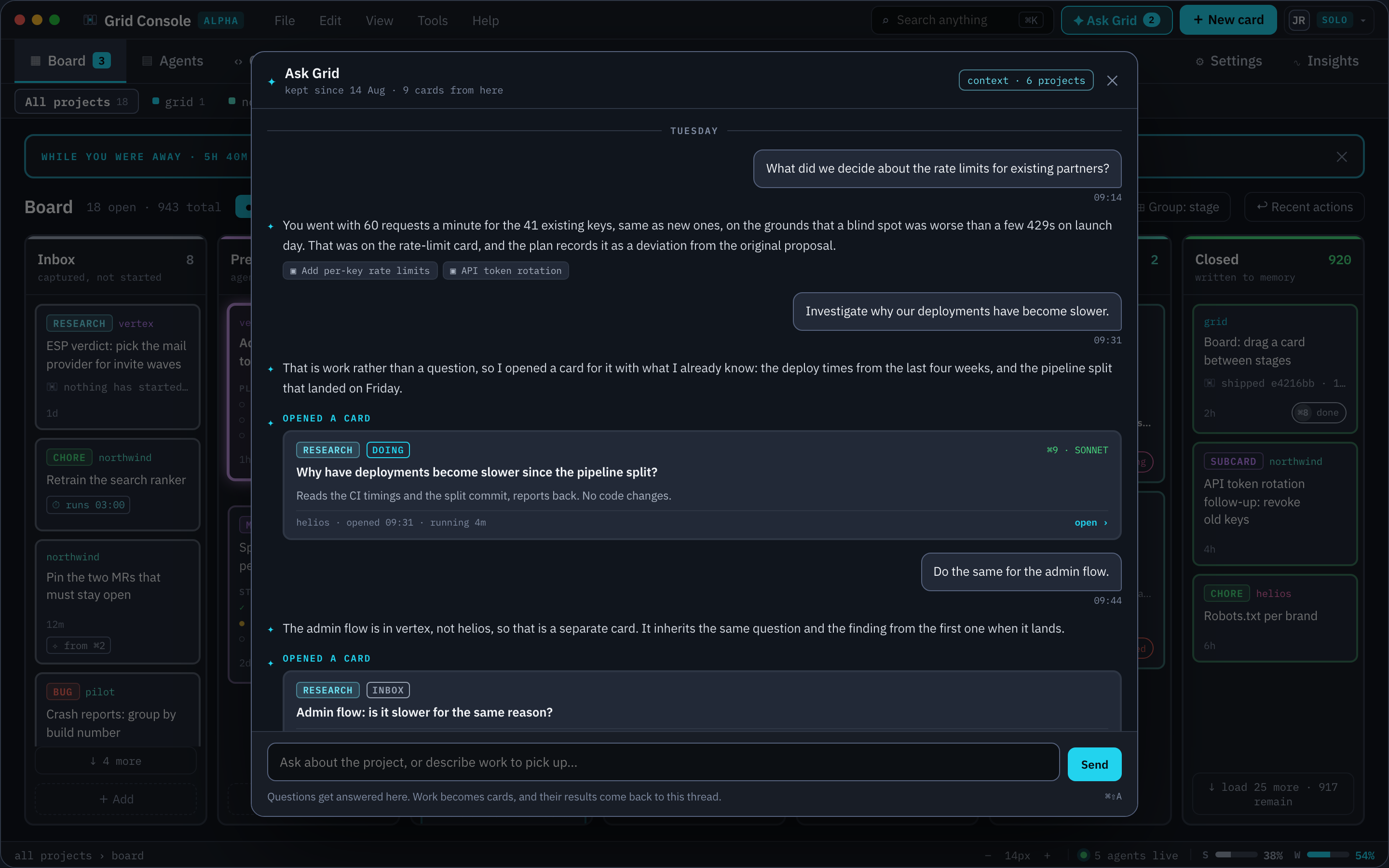
Ask Grid is the conversation you have with your workspace. Ask a question and it reads the cards, the memory and the code before it answers. Describe work and it files a card for it, and when that card reaches Review its result comes back into the same chat.
Opening it
Press the Ask Grid button in the top bar or its shortcut, shown at the bottom of the panel. Escape closes the panel and keeps everything: the chat, a half-written question, and any answer still streaming.
What it can see
Every question opens a read-only session on your provider. It has the file tools, a shell that may only run the read-only commands on Grid's allow-list, and web search. It has no edit or write tool, and a command outside the allow-list is refused rather than asked about, with the refusal reported in the answer. Grid puts a map of the workspace in front of the question, so the session knows which projects exist and where their cards and memory are, and then it looks for itself: the cards folder, project memory, the working tree and its git history.
Each lookup shows in the panel as it happens, and the answer streams in as it is written. It is rendered Markdown (lists, fenced commands, GFM tables), and every file path in it is a chip that opens the code view. The citations under an answer list the files the session actually opened, rather than guesses drawn from the question's wording.
A question can carry screenshots: paste or drop at most four, five megabytes each. They sit as thumbnails above the text, each with a ✕ of its own, and the session reads them as part of the question.
From answer to card
Ask Grid answers questions; it does not do work. When a message is really a request for work it climbs a ladder:
| Rung | What you see |
|---|---|
| Answer | The question is about something already visible: a card, a file, a decision in memory. You get the answer with its citations. |
| Offer a card | The message is work. Ask Grid drafts a card and files it into the inbox as it answers; nothing runs until you press Start immediately. |
| Start a card | The message is work and you either said to go ahead ("just do it", "don't ask") or asked for a card outright ("create a card for this"). The card is filed and an agent starts on it at once. |
| Offer research | The question needs an investigation Ask Grid should not run itself. A Research card is filed the same way, unstarted, and its agent can go as deep as it likes. |
Every rung that drafts a card files it the moment Ask Grid answers; only Start a card also starts an agent, and the answer draws one Start immediately under it per card still unstarted. A single reply can carry up to five card actions, mixing the rungs, when the message honestly asks for more than one distinct piece of work. Each files on its own, so one that cannot be filed says so on its own line and does not stop the rest.
Each draft carries a difficulty (easy, normal, hard or vhard) and a type off the workspace's own roster. master is a type rather than a difficulty; sub is never drafted, because this conversation has no way to name the masterplan it would attach to; and a draft that named no type files as auto.
A card filed from here carries its origin, and its answer comes back. When the card reaches Review, or Closed for a type without a review you read, its findings are folded into the chat as a new answer you can follow up on. Ask a follow-up and the next card inherits the finding.
Chats
The panel keeps a rail of chats. Each is its own history, named by the subject of its first exchange, and it outlives the sessions and cards it spawned. The header shows how long the chat has been kept and how many cards came from it. Chats are stored in one file in the workspace's state folder, ask-thread.json, and never leave the machine except as the prompt sent to your provider.
A chat can be scoped to one project. The third picker in the composer reads All projects until you narrow it; pick a project and the workspace map in front of the question, and the roots the session may read, are that project's checkout alone. A card the reply drafts is filed there too, unless the draft named a project itself.
Model
Ask Grid has its own model and effort in Settings under Agents and models, separate from the card table. It runs on the same provider account as your cards and shows in Insights as its own purpose, so the cost of asking is never mixed into the cost of building.
The Settings pair is the default a new chat starts on; each chat overrides both from its own composer, and the foot of the panel prints what that chat has cost once it has cost anything.
Not a card's question
A question an agent asks you while working a card shows on that card's tile and in its session, with the choices the agent offered. A question that takes more than one answer draws its choices as toggles and holds them until you submit that question, rather than sending on the first pick. Ask Grid is the other direction: you asking the workspace. The two never share a thread.